
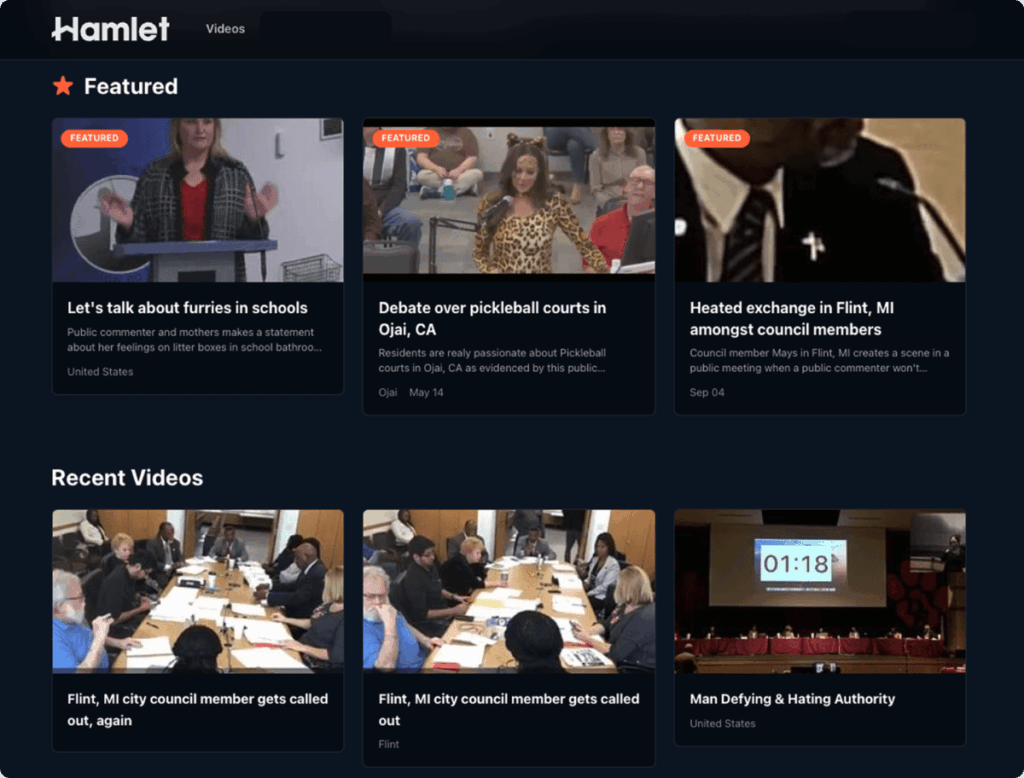
The launch of Hamlet was quite personal for Sunil Rajaraman.
Back in 2022, he ran for city council in a small California town. He lost, but the moment forever changed the way he saw the place — and local governments, for that matter.
“I was trying to become a better candidate,” he recalled to TechCrunch. “I wanted to understand how my city actually worked, what decisions had been made, why, who said what. And I couldn’t figure it out. It’s a total black box, and almost intentionally opaque.”
Since COVID, towns across the nation have started recording and posting their city meetings online. That gave Rajaraman an idea: a company that helped people understand what was happening in local governments. That same year, in 2022, he launched Hamlet to do just that.
“We use AI to process thousands of hours of city council and planning commission meeting videos and turn them into intelligence they can actually use,” he said. He said these videos are better than meeting minutes because those documents are just someone’s interpretations of what happened. “The video doesn’t lie.”
At first, he thought it would be a media company, but then real estate developers and political action committees started reaching out. Rajaraman realized that private companies have to deal with local governments, too, and they also want more insight into what is happening in those city council meetings.
For enterprise customers, the company helps track agendas and alerts them when relevant topics are addressed across target cities. It also synthesizes what happened after meetings, so they don’t have to watch hours-long videos, and it lets them search the video archive to see, for example, when and how a competitor was mentioned in a local government setting.
Techcrunch event
San Francisco
|
October 13-15, 2026
Hamlet has raised around $10 million in venture funding to date, from backers including Slow Ventures, Crosslink Capital, Bana Capital, and Kapor Capital. “We want to become the ‘Bloomberg’ of this space, so to speak,” Rajaraman said.
On Friday, Rajaraman announced he is expanding the company to launch Hamlet TV as a way to help keep regular citizens informed of what is happening inside their governments. The streaming channel is on TikTok, YouTube, AppleTV, and Instagram, and will spotlight important moments from council, commission, and school board meetings.
Rajaraman said his company has processed thousands of hours of government meetings for government customers.
“We’ve seen meetings that have lasted 15-plus hours without recess,” he said. He and his team started curating funny moments from those meetings, and they thought it was a good idea to use humor to get people more invested in the U.S. democracy. “If you show people procedural videos, they are just not going to care. But if you show them the funny stuff, they’ll watch.”
The most surprising thing he and his team have seen so far on Hamlet TV has been someone dressing up as a cockroach to address their city council about a pest problem. But it’s not the funny stuff that surprises him, he said. “It’s how consequential these meetings are and how invisible they remain.”
He cited an example from earlier this year when the Tucson city council rejected Amazon’s $3.6 billion data center. He said that the decision came after months of planning, but only a few people likely watched those videos to understand why it happened.
This isn’t Rajaraman’s first time running a business — or a media outlet. He co-founded the analytics platform Scripted and was twice the Entrepreneur in Residence at Foundation Capital. He also ran a publication called The Bold Italic and then sold it to Medium.
He knows Hamlet TV probably won’t be a money maker and reiterated that he’s doing this to get people more involved with the state of the country’s democracy. He also plans to give away the Hamlet tool to local journalists for free. “Data is great, but context matters so much,” he said.
Next, the Hamlet company is looking to work with government affairs, advocacy organizations, and renewable energy developers. “Democracy works better when people are watching,” he said. “We’re trying to make watching possible.”