Driverless cars are no longer restricted to the realm of sci-fi thanks to companies like Waymo deploying commercial robotaxi services in multiple cities. And a number of automakers, big and small, are trying to bring that same level of autonomy to personally-owned vehicles over the next few years.
If that happens, what kinds of things could you do with a personal AV? Maybe you’ll be able to send it to pick up food or run errands — the hope of a company called Autolane. Or, if you’re Tesla CEO Elon Musk, you think owners will want to deploy their cars into the world to offer rides to other people, creating a tidy, nearly effortless side-hustle.
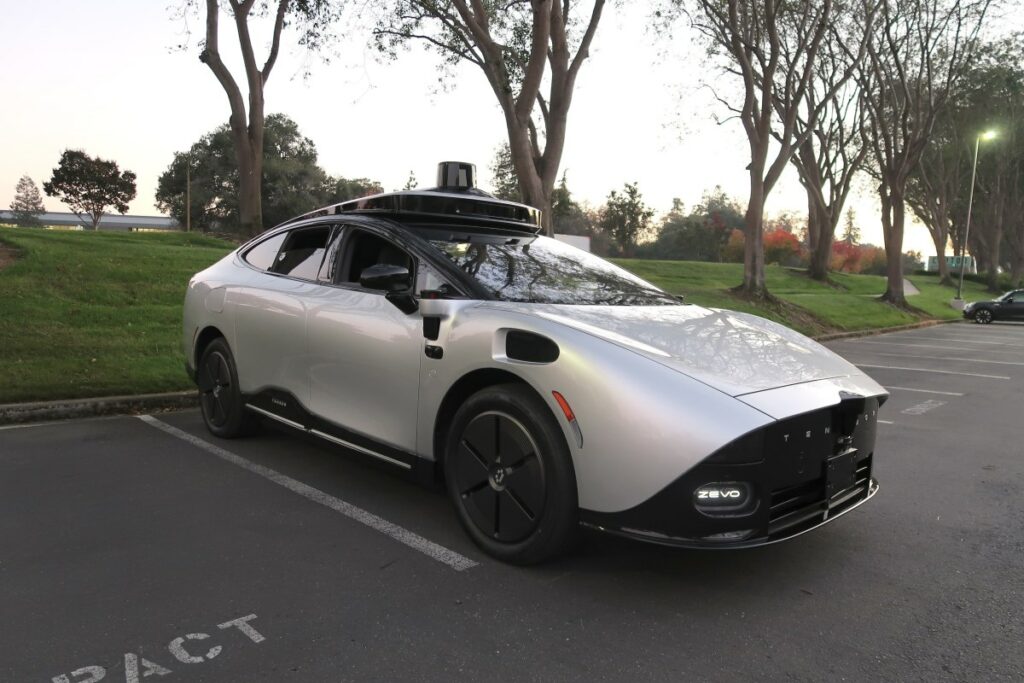
Hebron Sher, co-founder of Dallas-based Zevo, is eager to capitalize on all of the above. The company has been operating an EV-only, car-share fleet for a little over a year, and it’s now adding robotaxis, starting with a new company called Tensor.
Tensor is kind of an odd duck. The startup sort of emerged earlier this year from a previous Silicon Valley startup called AutoX that also had operations in China, and boldly claims that it will be the first to sell a fully autonomous car to regular consumers — in 2026, no less. Zevo says it will purchase up to 100 of Tensor’s cars and add them to its network.
There aren’t a lot of details on timing, and Tensor still needs to show that it can build cars at any kind of scale and reliability, which are massive hurdles that have tripped up many other newcomers in recent years. (The company said in a statement that its “path to shipping is driven by the pacing of global regulatory approvals, not product limitations.) If it works, Zevo customers would essentially be able to borrow the Tensor AVs in what amounts to a sort of decentralized robotaxi service.
The announcement resembles the many heady-yet-ultimately-unmet promises that were made a decade ago, when the self-driving car hype first peaked. But with real robotaxis on the roads now, the idea seems a little more tangible this time.
“Tensor’s vision is to build a future where everyone owns their own Artificial General Intelligence — a personal AGI that enables more time, freedom and autonomy,” Hugo Fozzati, Tensor’s chief business officer, said in a statement. “For us, this partnership with Zevo is not only just a batch sale of our vehicles, but also enables individuals and micro-entrepreneurs to participate and profit from AV business in this AI era.”
Techcrunch event
San Francisco
|
October 13-15, 2026
It won’t be Sher’s first bet on an unproven company. In October, Zevo announced a non-binding order of 1,000 vans from perpetually imperiled EV startup, Faraday Future. Faraday, which has struggled for a decade to make and sell its flagship FF91 luxury SUV, recently resorted to importing more affordable electric vans from China and assembling them in the U.S. The company is supposed to assemble the first of those later this month.
Sher’s willingness to bet on these companies stems from two reasons. One is cost: Tensor and Faraday Future have nonexistent and bad track records, respectively, and so they’re willing to cut an attractive deal. More importantly, Sher said, these companies are more willing than a major OEM to allow Zevo to tightly integrate with their vehicles’ software — a crucial factor if you’re going to allow peer-to-peer sharing, especially of robotaxis.
Not only is it tougher to get legacy automakers to be similarly flexible, but Sher said their “tech freaking sucks.” With newcomers, he said, “the synergy of startup and startup, sort of mingling, commingling together, and saying, ‘Let’s build a solution side by side…’ I think I’ve really enjoyed that experience.”
Sher paints the Tensor deal as a win-win for both companies: Tensor gets an early customer and a shot to prove that its robocars are real and can do what it promises; Zevo gets a good deal and that deep software integration.
But, he admits it’s a “calculated risk.”
“I think that’s what makes America great, you know, the fact that we do encourage startups to take risk,” he said.
This story has been updated to reflect that AutoX was headquartered in Silicon Valley.