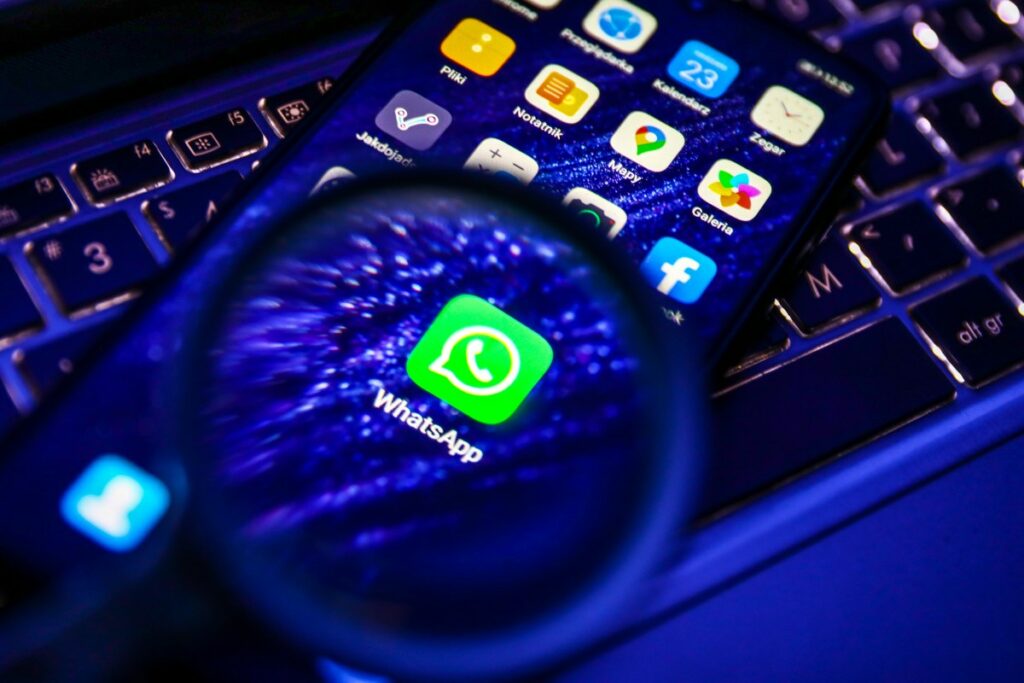
WhatsApp, Meta’s messaging app that millions of Indians rely on daily, is facing a critical moment in India as recent government directions threaten to disrupt how the platform works for everyday users and businesses.
Issued late last month and made public earlier this month, the directions ask certain app-based communication services to keep accounts continuously linked to an active SIM card and impose stricter controls on how the apps function across devices.
New Delhi says the measures are aimed at curbing rising cyber fraud in India, the world’s most populous nation. Digital advocacy groups, policy experts, and industry groups representing major digital platforms — including Meta — have warned, however, that the approach risks regulatory overreach and could disrupt legitimate use, especially in a country where WhatsApp has evolved into everyday infrastructure for personal communication and small-business commerce.
The directions, which app providers including Meta, Telegram, and Signal must comply with within 90 days of their issuance on November 28, require messaging apps to remain tied to the SIM card used at sign-up. The web and desktop versions of these apps also require users to log out every six hours and re-link their devices via a QR code to regain access.
“Mandatory continuous SIM–device binding and periodic logout ensure that every active account and web session is anchored to a live, KYC-verified SIM, restoring traceability of numbers used in phishing, investment, digital arrest, and loan scams,” the telecom ministry said in a press release earlier this month, adding that India suffered cyber-fraud losses exceeding ₹228 billion (about $2.5 billion) in 2024 alone.
The Indian government has clarified that the rules do not apply when the SIM remains in the device, and the user is roaming.
While the directions apply broadly to major instant messaging apps, their impact is likely to be felt most acutely by WhatsApp, which is used by more than 500 million people in India. The app’s adoption in India is also unusually deep. As much as 94% of WhatsApp’s Indian monthly user base opened the app daily in November, while 67% of WhatsApp Business users in the country did the same, according to Sensor Tower data shared with TechCrunch. By comparison, 59% of WhatsApp monthly users in the U.S. opened the app daily, alongside 57% for WhatsApp Business.
Techcrunch event
San Francisco
|
October 13-15, 2026
Many merchants in India rely on the WhatsApp Business app — a smartphone-based version of the service tailored for small enterprises — typically registering the account on a SIM-linked phone while handling customer conversations through WhatsApp’s web or desktop client on another device. Unlike larger companies that use WhatsApp’s Business APIs for automated, CRM-linked communication, these small businesses access their customers through WhatsApp Business and its companion web interface, meaning mandatory SIM binding and frequent forced logouts could break workflows for order-taking, support, and customer engagement.
The potential disruption in India comes as WhatsApp has been steadily expanding its multi-device and companion-device capabilities, allowing users and businesses to stay logged in across phones, browsers, and devices without relying on a single active smartphone.
Rapid expansion to deep entrenchment
The directions come as WhatsApp is undergoing a significant shift in India, its biggest market, with growth increasingly driven by retaining existing users rather than rapidly expanding its new user base.
WhatsApp’s monthly active users in India on mobile devices are up 6% year-over-year in the fourth quarter to date, even as downloads have fallen nearly 49%, per Sensor Tower data shared with TechCrunch. Compared with late 2022, WhatsApp’s monthly active users in India are up 24%, while downloads are down 14% over the same period, the market intelligence firm said.
“It could be fair to say that user (MAU) growth for WhatsApp in India across the past few years has been driven more by retention (successfully re-engaging existing or previous users) than acquiring new users,” said Abraham Yousef, senior insights analyst at Sensor Tower.
Data from Appfigures shows WhatsApp Business has consistently recorded more estimated first-time installs than WhatsApp Messenger in India since early 2024, reflecting how growth has increasingly been driven by merchant adoption rather than broad-based consumer expansion.

Part of that pattern reflects how WhatsApp is used in India, said Randy Nelson, head of insights at Appfigures. It is common for merchants to maintain separate WhatsApp identities for personal and customer communication, often enabled by dual-SIM phones, while a single business can generate multiple installs across staff and shop devices.
Sensor Tower data points in the same direction. WhatsApp Business monthly active users in India were still growing year over year in late 2025 and are up more than 130% compared with 2021, far outpacing WhatsApp Messenger’s roughly 34% growth over the same period, the market intelligence firm’s data estimates.
While overall engagement remains higher on WhatsApp — with Indian users opening the app daily and spending an average of 38 minutes a day in November, compared with 27 minutes on WhatsApp Business — the gap looks different in the U.S., where users spent about 23 minutes a day on WhatsApp and 27 minutes on WhatsApp Business, Sensor Tower estimates show.
India’s directions raise “serious questions of technical feasibility”
In a statement last week, industry body Broadband India Forum (BIF), whose members include Meta, said the measures could result in “material inconvenience and service disruption on ordinary users,” adding that they raise “serious questions of technical feasibility.”
The directions hinge on a new and still-contested classification of Telecommunication Identifier User Entities (TIUEs) under India’s telecom cybersecurity rules, said Kazim Rizvi, founding director of New Delhi-based public policy think tank The Dialogue, effectively placing messaging apps within a telecom framework — a shift from their traditional regulation under the country’s IT Act — through executive directions rather than formal legislation.
“The directions derive their power not from statute but from delegated legislation,” Rizvi told TechCrunch. “Moreover, the lack of public consultations or technical working groups risks creating compliance friction without addressing the underlying fraud vectors.”
India’s telecom ministry did not respond to a request for comments.
For now, companies including Meta have limited room to challenge the directions in court, according to tech policy experts.
Challenging the directions would typically require showing either that they exceed the scope of the underlying law or that they violate constitutional protections, said Dhruv Garg, a tech policy advisor and partner at the Indian Governance and Policy Project — a high bar that may be difficult to meet in this case.
Meta declined to comment on this article.